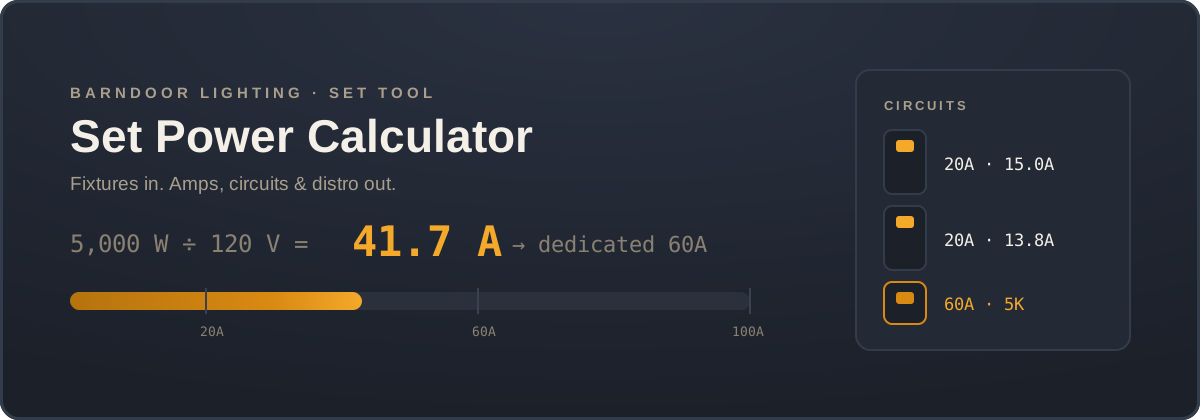
Short answer: Add up every fixture running at once, and the calculator below turns it into the numbers that matter — total amps, how many standard 20 A circuits you need, and any light big enough to require its own dedicated circuit. Remember that a single fixture can’t be split across circuits: a 5K pulls about 42 A, so it needs its own 60 A feed, not three 20 A’s. When in doubt, size up — and have a licensed electrician verify the install.
No fixtures yet — tap a preset above or add your own.
Add a fixture to see your power plan.
Estimates assume listed wattage equals draw. HMI and magnetic-ballast fixtures can pull 20–40% more than lamp wattage — when in doubt, call us. A single fixture can't be split across circuits, so fixtures are packed into 20A circuits one at a time (about one 2K / 2000W per 20A circuit at 120V). Any fixture that draws more than a 20A circuit can hold is flagged for its own dedicated higher-amperage circuit — a 5K, for instance, runs on a 60A Bates. For planning only; not a substitute for a licensed electrician. Always follow the NEC and local code.
Total draw (amps) is the real number your power source has to deliver — watts divided by volts. 20A circuits is how many standard Edison circuits your smaller fixtures need once they’re packed in efficiently. Any fixture flagged in the list is too big for a 20 A circuit and gets called out with the dedicated circuit it needs instead.
The whole game is one formula: Amps = Watts ÷ Volts. On a 120 V circuit, divide the wattage by 120. A 1K draws about 8.3 A, a 2K about 16.7 A, and a 5K about 41.7 A.
Then apply the 80% rule: continuous loads like lighting shouldn’t exceed 80% of a circuit’s rating, so a 20 A circuit gives you about 16 A of working headroom — roughly one 2K’s worth of light.
A fixture plugs into one outlet on one circuit. You can’t spread a single light across several circuits, so the practical ceiling on a 120 V/20 A circuit is one 2K (about 2,000 W / 16.7 A). Anything larger is more than that circuit can carry.
That’s why a 5K tungsten — roughly 42 A — isn’t “three 20 A circuits.” It’s one dedicated 60 A circuit (a 60 A Bates). A 10K steps up to 100 A. The calculator flags these automatically and names the circuit each one needs.
| Package | Fixtures | Total | Amps (120 V) | What you need |
|---|---|---|---|---|
| Small LED interview | 3× 200 W LED panel | 600 W | ~5.0 A | One outlet + a stinger |
| Run-and-gun HMI | 1× 1.2K HMI + 2× 300 W LED | 2,300 W | ~19.2 A | Two 20 A circuits |
| Tungsten 5K key | 1× 5K | 5,000 W | ~41.7 A | One dedicated 60 A circuit |
| Mixed feature rig | 2× 5K + 4× 1K | 14,000 W | ~116.7 A | 2× 60 A + 2× 20 A → 100 A+ distro |
Figures are illustrative and rounded for single-phase 120 V, and assume listed wattage equals draw. Your real numbers depend on actual fixture draw, phase, and voltage.
Divide watts by volts. At 120 V, a 1,000 W fixture draws about 8.3 A. Then apply the 80% rule for continuous use.
A 5K draws about 42 A — far more than any 20 A circuit can carry — and a fixture can’t be split across circuits, so it needs its own dedicated 60 A feed.
About one 2K’s worth (~16 A usable after the 80% rule) — for example two 1Ks, or a 1.2K HMI plus a small LED.
Yes. Amps = watts ÷ volts, so higher voltage means fewer amps for the same wattage. Use the voltage selector in the calculator.
Tell us your fixture list, your power source, and your connectors, and we’ll spec the distro and ends. We’ve built power for film, broadcast, worship, and live events since 1995 — and a real expert answers the phone. Call 888-276-3667.
Browse Distribution / Distro Boxes »
Related: What Size Distro Box Do I Need? »
This guide is for equipment selection. It is not electrical-design or code advice. Have a licensed electrician verify ampacity, terminations, grounding, and protection for your specific situation. Always follow the NEC and local code.



© Barn Door Lighting Outfitters LLC.