Short answer: Add up the wattage of every fixture that will run at once, divide watts by your voltage to get amps, then divide that by 0.8 to leave the required headroom for continuous loads. Choose a distro whose total feed and individual output breakers comfortably cover that number, and match the phase, voltage, and connector types to your power source. When in doubt, size up — and have a licensed electrician verify the install.
List every fixture, ballast, and accessory that will be powered at the same time, and total their wattage. Use the actual draw, not the bulb's nominal rating — an HMI's ballast and an LED's driver both pull more than the bare lamp figure suggests. If you don't know a fixture's draw, it's on the nameplate or the spec sheet.
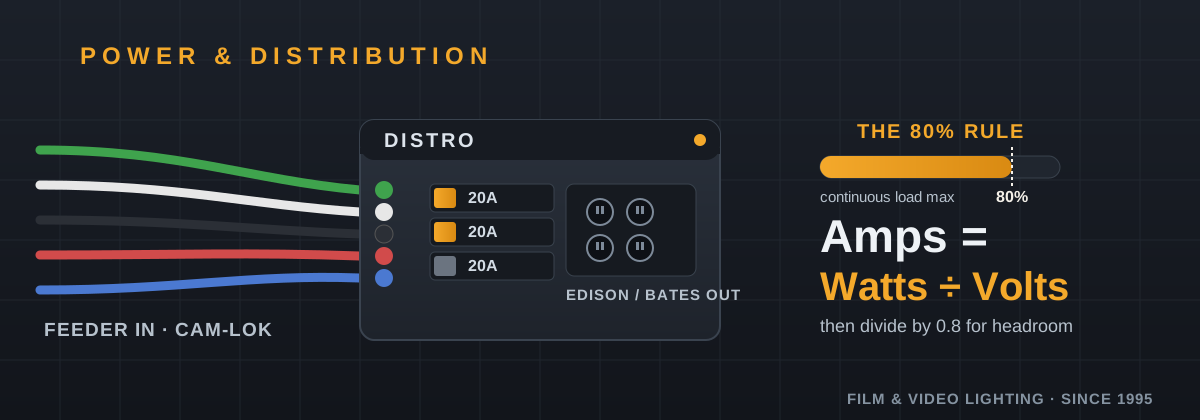
The basic relationship is Amps = Watts ÷ Volts. On a standard 120 V circuit, a 1,200 W fixture pulls 10 A. For three-phase distribution the math changes — line-to-line voltage (commonly 208 V) and the square-root-of-three factor come into play — which is one reason larger rigs move to three-phase distros and cam-lok feeder.
Lighting is a continuous load, and the electrical code limits continuous loads to 80% of a circuit's rating. In practice that means you size to your amps divided by 0.8. A circuit pulling 16 A continuously wants a 20 A breaker; load a 20 A circuit to its full 20 A and you're asking for nuisance trips and heat. Build the 80% cushion in from the start.
A distro is only useful if it fits your power source and your fixtures. Confirm single-phase vs. three-phase, the input voltage, the feeder connector style (cam-lok is the common feeder standard), and the output receptacles you actually need — Edison for small fixtures, Bates/stage-pin for larger draws, and the right breaker sizes per output.
| Rig | Total load | Amps (120 V) | With 80% headroom | Typical distro |
|---|---|---|---|---|
| Small LED kit | 2,000 W | ~16.7 A | ~21 A | Split across two 20 A Edison circuits, or one 30 A |
| Mid-size package | 6,000 W | ~50 A | ~63 A | ~100 A feed, mix of 20 A Edison + 60 A Bates |
| HMI-heavy feature | 20,000 W+ | 160 A+ | 200 A+ | Three-phase 200 A cam-lok distro, multiple branch boxes |
Figures are illustrative and rounded for single-phase 120 V. Your real numbers depend on actual fixture draw, phase, and voltage.
Divide watts by volts. At 120 V, a 1,200 W fixture draws about 10 A. Then divide by 0.8 to size the circuit for continuous use.
Continuous loads should not exceed 80% of a circuit's rating. Practically, you size your distro and breakers to your load amps divided by 0.8, leaving 20% headroom.
Small and mid-size rigs usually run single-phase. Once total draw climbs into the hundreds of amps, three-phase distribution with cam-lok feeder is more practical and balances the load across legs.
Cam-lok is the common feeder input. On the output side, Edison handles small fixtures, while Bates/stage-pin handles larger draws. Match output breaker sizes to the fixtures on each circuit.
Tell us your fixture list, your power source, and your connectors, and we'll spec the distro and ends. We've built power for film, broadcast, worship, and live events since 1995 — and a real expert answers the phone. Call 888-276-3667.
Browse Distribution / Distro Boxes »
Next: How to Calculate Feeder Cable Size »
This guide is for equipment selection. It is not electrical-design or code advice. Have a licensed electrician verify ampacity, terminations, grounding, and protection for your specific situation.



© Barn Door Lighting Outfitters LLC.