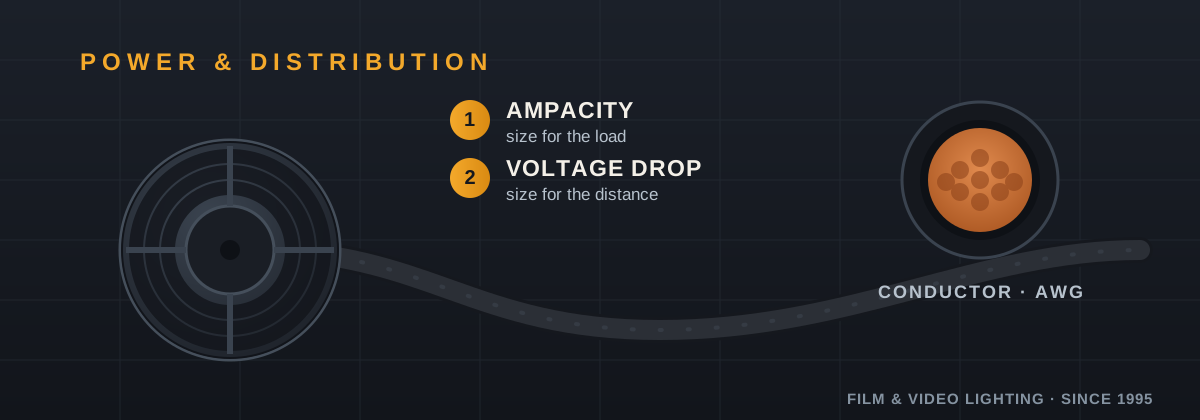
Short answer: Size feeder in two steps. First pick a conductor gauge whose ampacity meets or exceeds your load amps. Then check voltage drop for the run distance — short runs are usually fine on ampacity-sized cable, but long runs need the conductor upsized to hold voltage drop to about 3%. Size from the 75°C column unless every termination is rated higher, and never run current through a coiled reel.
Start with the amperage your distro or load will draw, then choose a cable gauge rated to carry at least that much current continuously. Bigger current needs a larger conductor — and AWG runs backwards, so a smaller number is a thicker wire. The table below shows approximate ampacities for single-conductor portable feeder cable; treat them as a starting point and confirm against the cable's own ratings and NEC Table 400.5.
| Conductor (AWG) | Approx. ampacity* | Typical use |
|---|---|---|
| 6 AWG | ~95 A | Small single-phase runs |
| 4 AWG | ~125 A | 100 A distro feeds |
| 2 AWG | ~190 A | Mid-size packages |
| 1/0 AWG | ~260 A | Larger feeder runs |
| 2/0 AWG | ~300 A | Three-phase distribution |
| 4/0 AWG | ~405 A | Large feature / venue feeds |
*Approximate single-conductor, free-air values near the 90°C rating, shown for comparison. Always verify against NEC Table 400.5 and the actual cable.
Ampacity tells you the cable won't overheat; it doesn't tell you the voltage will still be usable at the far end. Over distance, conductors lose voltage, and fixtures and ballasts misbehave when the voltage sags. As a rule of thumb, runs under about 100 ft are usually fine on ampacity-sized cable, while several-hundred-foot runs often need the conductor upsized one or more gauges to keep voltage drop near 3%. Calculate it for your actual load, distance, and voltage rather than guessing.
Match the cable's ampacity to your load first, then check voltage drop over your run length. If the run is long, upsize the conductor a gauge or two to keep the voltage at the far end usable.
Use 75°C unless every termination in the path is rated higher. The cable may be 90°C, but connectors and breakers often aren't, and the lowest-rated component sets the limit.
No. Coiled cable under load can't dissipate heat and can overheat. Pay out only the length you need.
Often yes. Modern LED and electronic loads can load the shared neutral significantly, so a full-size neutral is commonly specified. Confirm with a qualified electrician for your load.
Tell us your load, your distance, and your connectors, and we'll size the cable and ends. We've specced power for film, broadcast, worship, and live events since 1995 — and a real expert answers the phone. Call 888-276-3667.
Shop Feeder Cable & Connectors »
Read: What Size Distro Box Do I Need? »
This guide is for equipment selection. It is not electrical-design or code advice. Have a licensed electrician verify ampacity, terminations, grounding, and protection for your specific situation.



© Barn Door Lighting Outfitters LLC.